Saturday, November 28, 2009

A new DVD in the works

Lest you think I've fallen off the planet, I'd like to announce here that I'm now deep in the process of putting my new DVD together. Untitled as of this writing, it will be a survey and celebration of my non-wearable, sculptural artwork.

The main feature of the disc will be my first-time-available film from 1994, entitled 'The Dying Alchemist', which has been remastered and re-worked, and features incredible music, once again, by the inimitable Guy Klucevsek. It's a spontaneous romp through the making of one of my box sculptures in my studio in Westport, CT, from those early days of my output. It can be seen as the stylistic forerunner of 'Within and Without', the 2003 film I made with my partner Irena, that focussed on making a wearable piece.

There will be several other short film segments that have never before been made public, as well as a set of dynamic moving stills of sculptural work from 1988 to 2009, all cinematically set to music. Travel inside my sculptural work as never before. You can think of it as my website in joyful motion.

I'm having a blast sifting through my massive image archives and pulling out some pearls that are now only known by the people who bought them decades ago.

Below are some sneak-preview stills from 'The Dying Alchemist'.


Check back here for updates on the DVD's progress. Now it's back to work...

Ciao!

Keith

Sunday, October 25, 2009

Endings, beginnings

My visit to the US is nearing completion; I head back to Sydney and family on Tuesday for a long-overdue reunion. It has been a phenomenal experience this time 'round; extended visits with my parents and siblings made it soul-satisfying - not to mention highly unusual - as normally my teaching schedule is pretty unrelenting during my time in the US.

But it was professionally eventful as well. Teaching at the lovely 'Art Is You' event in Connecticut, lecturing to the excellent graduate metals students at East Carolina State University, under the virtuosic hands of Bob Ebendorf; lots of inspiration flying around for those days.

This past week has seen two exciting developments for me. First was the new acquisition by the MAD Museum (Museum of Arts & Design) in New York of my 2004 neckpiece 'RETROSPECTION'. Following on the heels of being published in Ursula Ilse-Neuman's beautiful book 'Inspired Jewelry from the Museum of Arts & Design', it's a wonderful opportunity for my more recent work to be viewed by a larger audience. The neckpiece will make its public debut at the museum in November of this year. The second remarkable event has been the purchase of my newest piece 'THE DIARY OF AN ANTIQUARY', also seen in progress in the previous 4 postings below. It couldn't have gone to better owners.

I'm looking forward to getting back into my studio in November and continuing to explore all these new avenues that my recent work has laid the groundwork for. So stay tuned.

Cheers,

Keith

Thursday, September 3, 2009

The Diary of an Antiquary, Part 4

Let's bring this piece to a close with this last epic posting. The enclosure more or less finished, I measured out the interior space to come up with the dimensions of the book (this ass-end-up retrofitting is just my style!).

I settled on this gorgeous leather cover from 1852 as my raw material for the final covers.


It was exciting to see the empty space occupied at last, if even for a moment.


Beginning the long process of cutting out the book pages in heavy gauge brass.


The raw elements stacked up, giving me a general feel for the proportions.


Each 'page' would consist of two plates of brass, riveted together, with elements trapped in the sandwich. Above, my three pages and covers.


Because of the substantial weight of these plates, I knew they would have to be pierced quite a lot to eliminate all that metal. The designs are loosely based on medieval iron grillework.


The six sheets taped together, forming 1/2 inch of solid brass. The holes for my sewing stations would have to be drilled through all at once.


The first page takes rough shape - the early part of twelve hours of very difficult sawing.


With throbbing hands, I examine the cut sheets of brass.


Couldn't resist making an ice-cream sandwich of it to see what it looked like, as I knew it wouldn't be so transparent once the elements came together.


A cacophony of grilles.


Now each sheet was shaped.


Page one, getting close. The three pages took three days to complete the metalworking.


Now for the really fun part of creating the visuals behind the metal. Sheets of mica would keep the pieces in check under the grilles. Here, Mrs. Col. Wm. Douglas lends her face to the cause.


An 18th-century engraving takes center on the other side.


The elements taking their places.


The smallest rivets I've ever made. Chalk up another first.


Carving space into the front cover for a pearl.


The window would allow Mrs. Douglas to peer through when the book was closed.


Page three metalwork.


Mica measured and cut to size.


On to the binding. For this stage I have Keith Smith to thank, for his excellent book 'Smith's Sewing Single Sheets', which was my manual for this part. I built this frame to hold the raised cords of the binding upright for easier sewing. The frame is about half the size Smith laid out - plenty of size for a miniature book, however!


Ready to sew the bottom page on.


Second page gets added...


The book block ready for some covers.


This part was seriously daunting. The cords are 7 strands each of heavy antique linen, as I wanted a chunky profile for the spine.


The cord unwound and poking through the cover - now each strand needed to be frayed to lay flat against the inside cover for gluing...


...like so.


The back cover with frayed threads ready to be glued in place and covered with end paper.


The front cover was even more difficult due to the window. Note the recessions cut in to allow the thread to lay flush on the board.


Exsquisite end paper from the 1860's to paper over the thread.


The book needed a closure, so I fiddled about until I came up with the solution. I would use this old fork, dug up in England as my material.


Brittle and fracturing even after annealing, but it held strong - I even liked the cracks, so away we went.


Part of the business end would be used as well.


Before soldering together.


Terrifying task #4,360: putting a large hole into a finished book, to create a strong metal tube that would allow the mechanism to move without damaging the fragile book board.


As the book, now completed, got attached permanently to the enclosure via a long chain, I needed to scoop out recesses in the box to accomodate the protruding clasp.


Last step was creating a visual interior for when the book was removed from the housing. The gem for this job was the left-hand side of this awe-inspiring page of illuminated manuscript from the 1500's. It was given to me along with some others by a generous student (is that Ukrainian, I seem to remember? Anyone?). It seemed a fitting treasure see when the box was open.

Thanks for walking with me through this important piece in my output as a maker. This post is a week later than I thought, as it took an entire week to photograph the finished piece.

Which you can see here.

Hope you've enjoyed the ride - I know I have.


Sunday, August 23, 2009

The Diary of an Antiquary, Part 3

Welcome back. This third post in the in-progress series of the making of The Diary of an Antiquary begins with the construction of the chain structure for the hinged box, that by this point I had decided would house a handmade book. My plan was to make it worn very low, at or below the waist, to recall the girdle books from centuries back, albeit in a very different form. Although at this stage the book had yet to be made (I'd cross THAT bridge...) I did envision that the book would be removeable from the box, but chained to it, and so married to the holding structure.

In imagining the chain for this piece, I began to mull over different materials than I was used to working with for this purpose. I'm not sure what got me thinking about wood, but soon I was readying to try whittling a 'whimsy' - the age-old practice of carving shapes in wood that was often mastered by sailors on their long voyages. I have a few antique examples - both are cages that contain balls that move inside them, carved from a single piece of wood. So I began by choosing a length of wood that would lay over the shoulder and neck (I wanted the piece to be worn not like a necklace but over the shoulder like a handbag). This first group of images shows the links being created from a strip of maple. I didn't photograph the wood before I began cutting, but it was a rectangular block that I then rabbeted out along its length as shown.


The links are now roughed out in size.


Removing wood from the interiors of the links.


A big moment is when the first link comes free...


...and can be shaped.


Working along the length, shaping them as I go.


The links ready to be painted.


video

A short video of the aftermath.


Painting the chain to harmonize with the box.


Next came another part of the chain - which would be straight bars, with decoration turned into them - to hang along the length. Here the brass segments have been hardened and textured and are ready to be sized and turned.


Cutting large steel jump-rings to use as the bulk of the chain.


The long links finished and ready to integrate with the steel chain.


Wood, brass and steel rubbing elbows.


Getting the length established, I snap myself in the mirror with the piece on.


Then I find a much more attractive model (in-house, of course!).


At this point it occurred to me that I would like to have the box mounted on a stand, so it could be elegantly displayed when not worn (because of the design thus far, it wasn't able to stand upright on its own).


As a base, I settled on an antique Indian candle-holder of cast brass and cut it apart.


One of the very few solder joins in this piece being prepared.


Fabricating little posts to protrude from the bottom of the box, to straddle the bar of the stand.


The posts installed on the box.


The stand completed (the horizontal bar is wrapped in 1920's linen thread, which I'll use much more of later).


Small 'claws' grip the posts on both sides of the box...


...and the posts, seen from the back here, keep the piece stable.


Now there were absolutely no more excuses for pushing the book until later - it was time to tackle it. The home was ready for its occupant.

So I plunged nose-down into Keith Smith's excellent book 'Smith's Sewing Single Sheets' and got my head together to try another first for me - fabricating and binding a book.

Stay tuned for the next and final post, which will see the piece to completion.

KL

Sunday, August 16, 2009

The Diary of an Antiquary, Part 2

Welcome back for episode two in the 'Diary' chronicles...

Once I had gotten the hinge working on the enclosure, I began to see it as a housing to hold something removeable. As I was sitting with the stucture talking about it with my partner Irena, she held it off to the side of her stomach and commented that it would be interesting for it to hang low, and it got my mind racing - her feedback is always right on target, I'm a lucky man. Soon I came around to thinking about girdle books, which had always fascinated me. Once quite common, only about 25 have survived the centuries; these were books bound to be hung from the clothing - here are a few examples.

(Girdle book from the British Museum)

The piece was now in high gear, as I began to envision a small book to inhabit the low-slung box. That would be a whole different set of problems, as I'd never bound a book myself. I'd have time to mull on that - there was plenty on my plate first. I found the title for the piece at this point, from a newspaper from about 1870. So the next step was to create a plate for the top of the box that would incorporate the title, as well as some kind of hook and eye closure. This jogged my memory to 2004 when I photographed the incredible armor at the Metropolitan Museum in NY. I had taken many images of interesting metal connections, and this supplied the inspiration for the catch I was about to fabricate.


Getting ready to etch the brass plate.

Etching in cupric chloride.


The closure begins.


The design for the plate.

Coming together...


Creating four brass 'bumpers' to protrude from the front and back of the box.


Ready to tube-rivet the hook mechanism.

The top plate complete, with fresh-water pearls set under the swinging hook.


The box nearing completion, I now would turn my time towards creating a really special chain for it to hang down to the 'girdle'. The next post will show you the very unconventional solution to that next challenge - and would find me chalking up another 'first' in my repertoire of making.

Until then, ciao!

Your feedback is most appreciated.


Sunday, August 9, 2009

The Diary of an Antiquary, Part 1

OK, time to make our way into my new piece, which at the time of this writing is still unfinished. As you'll see, there were many wrong turns, unexpected twists and first occurances during the last month of working on this, my most ambitious wearable work.

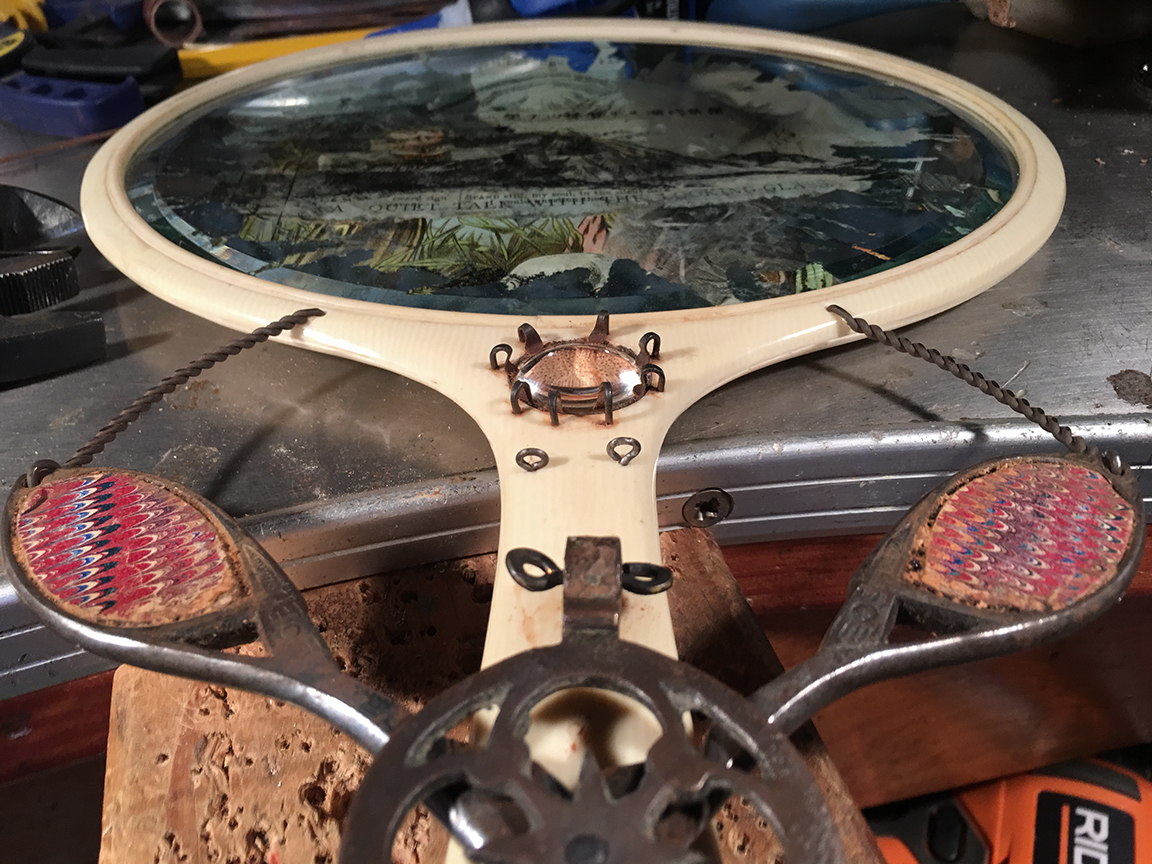
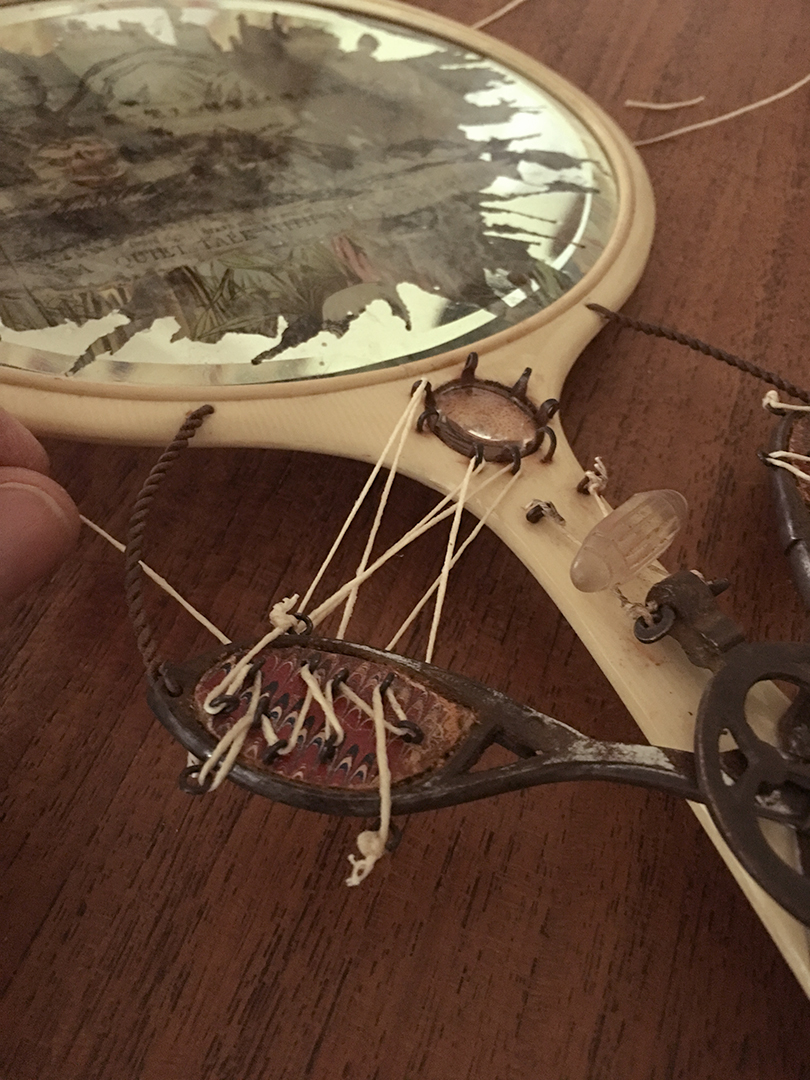
The springboard object that began the process for me was this lovely wooden frame that housed two thick glass lenses; this assembly was made for a hand-held stereoopticon, or 3-D viewer, from around 1870. I picked it up in Baltimore, as I recall, a few years back. Right in the antique store I saw the potential for this object to be sawn into an enclosing structure, and so it was with this in mind, and nothing else, that I began working. This was begun back in late June, during the construction of 'Two Sides of History.'

The committment is made!


I made the provisional decision not to use the lenses in this piece, as they are very very heavy. They'll wait for a future opportunity, so into storage they go.


This simple strap hinge, from an old Sterno can cover, served as inspiration for the hinge design.


A key was chosen to act as a turning handle that will open and close the two halves. This key would later fail (see below) and be replaced with a stronger key.


The key cut down and being readied for drilling, to accept a brass bar.


It was this small rivet that compromised the integrity of this key and bar, and I didn't trust its structural strength, so the next key was soldered in place.


Designing the hinge, using a photocopy of the bottom of the wood frames as a template.


Sawing the hinge.


The sides will bend around the wood.


The hinge starting to be shaped.


The brass bar has been soldered to the middle knuckle of the hinge.


Now the wood iwas carved out to allow the hinge to be recessed a bit.


And two beautiful labradorites were inserted into drilled holes.


'KL - IX' was pierced into the hinge...


...and backed with a doublet of New Zealand paua shell.


With attention turned towards the glass panels, I tried four different designs, none of which felt right. Above, one of the attempts. The iridescent silver glass has been slumped into a brass keyhole. It will be saved for possible future use.


Much more suited to my structure are these two beautiful pieces of opalized glass I unearthed from my garden after I moved in to the house a few years ago.


A page from a Victorian children's book.


She was affixed to one of the glass panels. The other I decided to keep unadorned.


Coming up with the scaffolding around the wood, allowing the piece to hang, involved a few days of unsuccessful pathways. I've learned over the years not to lose heart, as it seems when I'm most at a loss, the solution is about to show itself. Which it did. I've had this lovely object for about 12 years, just waiting. I believe it is part of a horse harness or farm equipment - can anyone elaborate? Would love to get more info about it.


Removed from the rest of the object, this will be a real focal point and provides the asymmetry that gives my brain the most satisfying problems to solve.


Fabricating elements to help everything hang.


The two long bars will run down the sides of the wood.


Serendipity stepped in and I came up with a new, lo-tech way to turn designs into the bars. Wow, this was a major discovery for me, and one I'll make a lot of use of. I chuckled for hours about this.


Laying the elements into position, I can assess how it will start to come together. There were some big unexpected changes on the horizon as I got ready to fabricate a unique hasp to close the box on top.

Tune in later in the week for the next installment.

- Keith

Tuesday, August 4, 2009

Big things brewing...

Things are cooking here in Studio Lo Bue. I've been at work for a month on my latest piece, entitled 'THE DIARY OF AN ANTIQUARY.' It is proving to be the most difficult, complex and rewarding wearable artwork I've yet made. It involves multitudes of new techniques and forms; among those, it features my first bound book as well as the most intricate metalworking I've done.

Watch here within the next week, and I'll put up my first installment of its construction.
 
Provided by www.mba-online-program.com .